



Yes, our inventory is accurate!
 Qualifies Towards Free Ground Economy Shipping (CONUS Only) For Most Orders Of $149 Or More
Sharper planets when they sit low in the sky
Why we like the ZWO ADC:
- Fixes what software can't: low in the sky, the air spreads a planet into a blue fringe on one side and a red fringe on the other. Shifting color channels in software lines them up again, but each channel stays smeared. The ADC removes the spread optically, before the light reaches the camera.
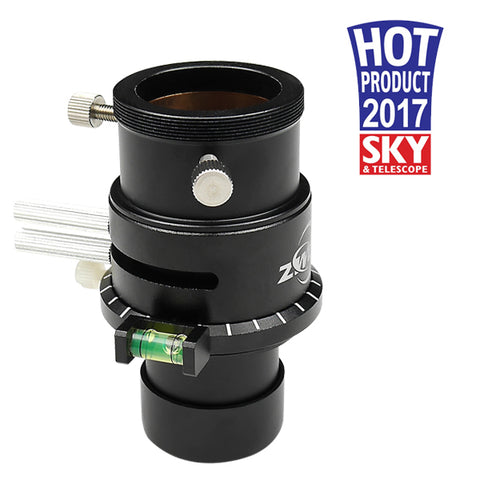
- Simple to set up: a bubble level squares it to the horizon and two levers dial in the correction while you watch the planet on screen.
- Good glass: two λ/10 prisms in H-K9L (equivalent to Schott BK7) with a UV-friendly anti-reflection coating that transmits over 98% from 370 to 650nm in ZWO's test curve.
- Worth knowing: it's a 1.25" accessory with a 22.6mm clear aperture, made for planetary, lunar and color video work at long focal lengths. It doesn't help deep-sky imaging, and when a planet is high overhead there's little for it to correct.
The ZWO Atmospheric Dispersion Corrector (ADC) uses two adjustable prisms to cancel the color spreading that the atmosphere adds to planets near the horizon. It goes between your Barlow or telescope and a planetary camera such as the ASI585MC or ASI662MC, and it also takes 1.25" eyepieces for visual use. It's 83.4mm (3.3") long with its 1.25" nosepiece and holder, and Sky & Telescope named it a Hot Product for 2017.
Key specs: two 2° prisms · H-K9L (BK7 equivalent) glass, λ/10 surface accuracy · UV-friendly AR coating · 22.6mm clear aperture · 1.25" nosepiece and 1.25" holder · M42 × 0.75 (T2) threads both ends · built-in bubble level and scale

What you can image
- Jupiter and Saturn when they sit in the southern part of the ecliptic, as Saturn has in recent years, and never climb high from Colorado.
- Mars near opposition, when its small disk shows color fringing first.
- Venus and Mercury, which you usually catch low in twilight.
- The Moon at low altitude, for crisper craters at the terminator in color.
- Visual observing: with a 1.25" eyepiece in the holder, it cleans up the color fringes you see on a low planet at high power.

How it works
Air bends blue light a little more than red, so near the horizon a planet becomes a short vertical rainbow. Inside the ADC, two thin prisms bend the light back the other way. Swing the two levers apart and the correction grows. Bring them together and it shrinks to zero.
- Put the ADC after your Barlow, just in front of the camera. You can leave the 1.25" holder on, or remove it and thread the camera straight onto the M42 × 0.75 thread for a shorter train.
- Turn the ADC in the focuser until the bubble is centered. That puts the prisms square to the horizon.
- With the levers together, aim at the planet and look at the blue and red edges in your capture software.
- Move the two levers apart, the same amount each way, until the fringes disappear. Note the scale reading for next time.
As the planet climbs or sets during the night, the right setting changes, so nudge the levers again between capture runs.
Using it in Colorado
Our thinner air helps: at Denver's altitude there's about a sixth less atmosphere overhead than at sea level, so dispersion is a little smaller at the same elevation. But planets on the low part of the ecliptic still sit 30° or less above the southern horizon from here, and that's where the ADC makes the biggest difference.
What to add for the best results
- A planetary camera (required for imaging): the ZWO ASI585MC for Jupiter, Saturn and the Moon, the ASI662MC or ASI664MC for smaller budgets, or the ASI715MC for its tiny pixels.
- A Barlow: the Celestron 2x X-Cel LX or 3x X-Cel LX brings a typical scope to the f/15 to f/25 range used for planetary imaging.
- ZWO IR cut filter: keeps infrared out of a color camera so stars and planets stay sharp. Color cameras with a clear window need one.
- A telescope with focal length: an SCT such as the Celestron NexStar 8SE is a classic planetary scope.
ADC vs. software RGB alignment
| ZWO ADC | Aligning color channels in software | |
|---|---|---|
| Corrects color offset | Yes | Yes |
| Corrects the smear inside each color | Yes | No |
| Works with a mono camera and filters | Yes, especially with broad filters | Yes, each filter is captured separately |
| Helps visual observing | Yes | No |
| Best for | Planets below about 50° with a color camera or eyepiece | A quick fix on planets that sit high |
See all ZWO planetary cameras.
What's in the box
- ZWO ADC with 1.25" nosepiece and 1.25" holder
The camera, Barlow and filters are sold separately.
ZWO ADC FAQ
Do I need an ADC for planetary imaging?
Not when a planet is high. Below about 50° altitude, and especially below 30°, an ADC makes a visible difference with a color camera or an eyepiece. ZWO's comparison images on this page show Jupiter at 49°.
Where does it go in the imaging train?
Most imagers put it after the Barlow, right in front of the camera. A slower light cone (f/15 or slower) makes the correction easier to set.
Can I use it visually?
Yes. Put a 1.25" eyepiece in the holder, level the ADC with the bubble, and adjust the levers until the colored edges on the planet go away.
Does it work with a mono camera?
Yes, but it matters less. Each filter is captured on its own, so the color offset between them can be aligned in software. With broad filters such as a luminance or red filter, the ADC still tightens detail.
Specifications
| Optics | |
|---|---|
| Design | Two counter-rotating dispersion prisms |
| Prism material | H-K9L (Schott BK7 equivalent) |
| Surface accuracy | λ/10 at 632.8nm |
| Prism deviation angle | 2° |
| Coating | UV-friendly anti-reflection; over 98% transmission from about 370 to 650nm (ZWO test curve) |
| Clear aperture | 22.6mm |
| Mechanical | |
| Telescope side | 1.25" nosepiece (27.5mm), removable; M42 × 0.75 thread |
| Camera / eyepiece side | 1.25" holder with thumbscrews (25mm), removable; M42 × 0.75 thread |
| Length | 83.4mm (3.3 in) with nosepiece and holder; body 29.4mm |
| Body diameter | 46mm; 52mm across the scale ring |
| Adjustment | Two levers with scale; built-in bubble level |
| Model / SKU | ZWO-ADC |