



Yes, our inventory is accurate!
 Qualifies for Free Ground Economy Shipping (CONUS Only)
An affordable, fast planetary camera that also guides
Why we like the ASI662MC:
- A low-cost start in planetary imaging: the same 2.9µm pixel size as the ASI585MC on a smaller, less expensive 1080p sensor, with read noise down to 0.8e⁻ and zero amp glow.
- Very fast: up to 107.6 frames per second at full 1920 × 1080, so you collect more frames in the moments of steady air.
- Two jobs in one: a sensitive STARVIS 2 sensor and an ST4 port make it a capable guide camera when it isn't on the planets.
- Worth knowing: the 5.6 × 3.1mm sensor gives a small field, so the whole Moon won't fit on most telescopes. For lunar and solar disks, the ASI585MC or ASI664MC covers more sky.
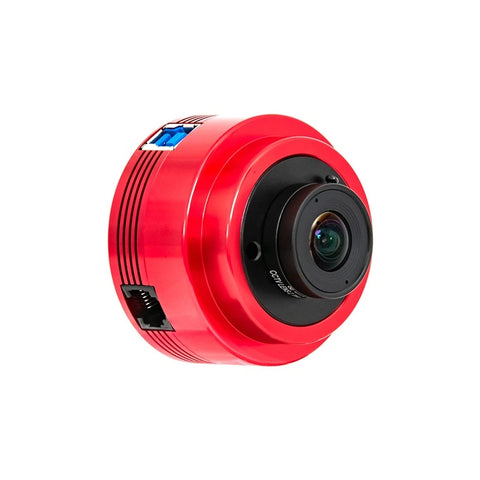
The ZWO ASI662MC is a color planetary camera built on Sony's 2.1-megapixel IMX662 STARVIS 2 sensor. It records high-speed video of Jupiter, Saturn, Mars and the Moon that stacking software turns into sharp images, and it doubles as a guide camera for deep-sky imaging. It replaces the ASI462MC with a deeper full well (38.2ke⁻), higher QE and no amp glow. It slides into any 1.25-inch focuser with the included nosepiece, threads onto M42 adapters, runs from one USB cable and weighs 126g (4.4oz).
Key specs: Sony IMX662 STARVIS 2 color sensor, 1/2.8" (5.6 × 3.1mm) · 2.1MP (1920 × 1080) · 2.9µm pixels · read noise 0.8e⁻ at high gain · 38.2ke⁻ full well · 91% peak QE · 107.6 fps at full resolution · zero amp glow · USB 3.0 with 256MB buffer · 126g

What you can capture
- Planets: Jupiter's cloud belts and moons, Saturn's rings and Cassini Division, and Mars near opposition. On an 8-inch SCT at f/15 (with a 1.5x Barlow) the field is about 6.3′ × 3.5′, plenty for any planet.
- The Moon: detailed views of individual craters and mountain ranges. On an 8-inch SCT at f/10 the field is about 9.4′ × 5.3′.
- The Sun: sunspots and granulation with a white-light solar filter, or prominences through a hydrogen-alpha solar telescope.
- Guide stars: on a ZWO 30F5 guide scope (150mm) the field is about 2.1° × 1.2° at 4 arc-seconds per pixel.
- Bright deep-sky objects: live-stacked views of bright nebulae and globular clusters.
How it works
Plug the camera into a laptop's USB 3.0 port with the included 2m cable, put it in your focuser with the 1.25" nosepiece, and record short video clips in free software such as FireCapture, SharpCap or ZWO's ASIStudio. AutoStakkert! keeps the sharpest frames and stacks them. No separate power supply is needed.
For planets, aim for about f/12 to f/15 with these 2.9µm pixels. That's an 8-inch SCT with a 1.5x Barlow, an f/6 refractor with a 2.5x Tele Vue Powermate, or an f/5 Newtonian with a 3x Barlow. High Conversion Gain (HCG) mode turns on automatically at gain 200 to keep read noise low. The sensor sits 12.5mm behind the front of the camera.

What to add for the best results
- ZWO IR cut filter (1.25"): for natural color and sharper focus, especially on refractors.
- A Barlow or Powermate: the Tele Vue 2.5x Powermate or Celestron 3x X-Cel LX Barlow to reach about f/15 on faster telescopes.
- ZWO Atmospheric Dispersion Corrector: removes the color fringing on planets low in the sky.
- A solar filter (required for the Sun): a full-aperture white-light filter such as the EclipSmart filter for 8" SCTs.
- ZWO 30F5 guide scope: if you'll also use it for guiding.
ASI662MC vs. ASI715MC vs. ASI664MC vs. ASI585MC
| ASI662MC | ASI715MC | ASI664MC | ASI585MC | |
|---|---|---|---|---|
| Sensor | IMX662, 1/2.8" | IMX715, 1/2.8" | IMX664, 1/1.8" | IMX585, 1/1.2" |
| Resolution | 1920 × 1080 (2.1MP) | 3864 × 2192 (8.5MP) | 2704 × 1536 (4.2MP) | 3840 × 2160 (8.3MP) |
| Pixel size | 2.9µm | 1.45µm | 2.9µm | 2.9µm |
| Full well | 38.2ke⁻ | 6.03ke⁻ | 36.5ke⁻ | 40ke⁻ |
| Max frame rate | 107.6 fps | 45.1 fps | 95 fps | 46.9 fps |
| Best for | Planets on a budget, and guiding | Planets on short telescopes without a Barlow | A bigger field at high speed | Moon, Sun and planets with the widest field |
See all ZWO planetary and all-sky cameras.
What's in the box

- ASI662MC camera
- Front cover
- Small wide-angle lens (threads onto the camera front)
- 1.25" nosepiece
- USB 3.0 cable (2m)
- ST4 guide cable
- Quick guide
Filters, Barlows and the telescope are sold separately.
ZWO ASI662MC FAQ
Is the ASI662MC good for beginners?
Yes. It's one of the least expensive ways into planetary imaging: USB-powered, color, and it fits any 1.25" focuser. Its small sensor means you'll need to center the planet carefully, so a GoTo mount that tracks well helps.
Which camera is best for Jupiter and Saturn?
On an 8-inch or larger telescope with a Barlow, the ASI662MC does an excellent job for the money. On a short refractor with no Barlow, the ASI715MC's 1.45µm pixels give a larger image. If you also want the Moon and Sun, step up to the ASI585MC.
ASI662MC or ASI664MC?
Both have 2.9µm pixels. The ASI664MC has a larger sensor (7.8 × 4.5mm) and lower read noise, so it frames more of the Moon and is easier to keep a planet on. The ASI662MC costs less and is a little faster.
Can I use it as a guide camera?
Yes. It has an ST4 port and guides over USB with PHD2 or ASIAIR. On a 30mm guide scope it covers about 2.1° × 1.2°, which is plenty to find guide stars.
Can I image the Sun with it?
Yes, but only with proper solar filtering on the telescope: a full-aperture white-light filter or a dedicated hydrogen-alpha solar telescope. Never point a telescope at the Sun without one.
Specifications
| Sensor | |
|---|---|
| Sensor | Sony IMX662 STARVIS 2, back-illuminated, color |
| Format | 1/2.8", 5.6 × 3.1mm (6.45mm diagonal) |
| Resolution | 2.1MP, 1920 × 1080 |
| Pixel size | 2.9µm |
| Shutter | Rolling |
| ADC | 12-bit |
| Read noise | 0.8–6.9e⁻ (HCG mode from gain 200) |
| Full well | 38,200e⁻ |
| Peak QE | About 91% |
| Amp glow | None |
| Performance | |
| Frame rate | 107.6 fps at 1920 × 1080 |
| Cooling | None (uncooled) |
| Guiding | ST4 port |
| Physical and connections | |
| Protective window | AR-coated, 21mm × 1mm |
| Data and power | USB 3.0 with 256MB DDR3 buffer |
| Mounting | 1.25" nosepiece; M42 × 0.75 front thread; 1/4"-20 tripod hole |
| Back focus | 12.5mm |
| Body diameter | 62mm |
| Weight | 126g (4.4oz) |
| Warranty | 2 years (ZWO) |
| Model / SKU | ZWO-ASI662MC |