



Celestron
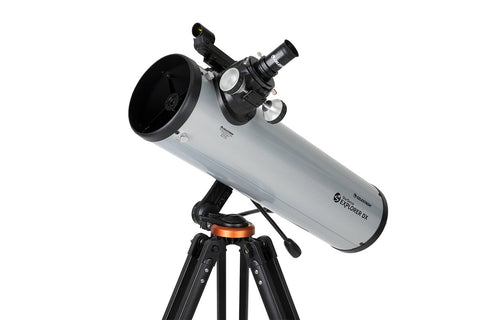
Celestron StarSense Explorer DX 130AZ Reflector Telescope
SKU: 22461
Yes, our inventory is accurate!
 See It In Person - On Display In Our Showroom!
 Qualifies for Free Ground Economy Shipping (CONUS Only)
A 5" reflector that uses your phone to find galaxies, nebulae and planets
Why we like the StarSense Explorer DX 130AZ:
- Finding things is the easy part: the StarSense app reads the sky through your phone's camera and shows arrows to your target, so you spend the night observing instead of searching. No batteries or motors needed.
- More light for the money: the 130mm mirror gathers about 60% more light than a 4" refractor, so star clusters, galaxies and nebulae look brighter.
- A wide, easy field: at f/5 it frames big targets like the Pleiades and the Andromeda Galaxy, and the eyepiece sits at a comfortable height near the top of the tube.
- Worth knowing: like any Newtonian reflector, the mirrors need an occasional collimation check. It takes a few minutes, and we're happy to show you how in the store.
The Celestron StarSense Explorer DX 130AZ is a 130mm (5") Newtonian reflector on a manual alt-azimuth mount with Celestron's StarSense smartphone dock. Clip your phone into the dock, open the free StarSense Explorer app, and it builds a list of what's up tonight and guides you to each object. It's a strong first telescope for anyone who wants to go beyond the Moon and planets, and the whole kit weighs 18lb (8.2kg).
Key specs: 130mm (5.1") Newtonian reflector · 650mm focal length, f/5 · 25mm (26x) and 10mm (65x) eyepieces · highest useful magnification 307x · StarSense smartphone dock · manual alt-az mount with slow-motion controls · 49" aluminum tripod · 18lb total
The StarSense Explorer DX 130AZ is on display in our Denver store, so you can see it in person before you buy.

What you'll see
- The Moon: craters, mountain ranges and rilles in crisp detail.
- Planets: Saturn's rings, Jupiter's cloud belts, Great Red Spot and four largest moons, the phases of Venus, and Mars near opposition.
- Nebulae: the Orion Nebula with its Trapezium stars, the Lagoon and Swan Nebulae, the Ring Nebula and the Dumbbell Nebula.
- Galaxies and clusters: the Andromeda Galaxy, M81 and M82, the Hercules Cluster (M13) and the Pleiades, best from darker skies.
How it works
Put your phone in the StarSense dock and align the dock to the telescope once, using a bright star or a distant object in daytime. It takes about 2 minutes. After that, the app recognizes star patterns through your phone's camera, works out where the telescope is pointed, and shows arrows that lead you to your target. When the bullseye turns green, it's in the eyepiece. The app also explains what you're seeing.
The mount has slip clutches and slow-motion knobs on both axes, so you can swing it quickly and then make small moves to follow an object as it drifts. The telescope needs no power. Celestron lists the current app as compatible with iPhone XR or newer (iOS 18+) and Android 12 or newer, so check your phone on Celestron's compatibility page before you buy.
Using it in Colorado
- City skies: the Moon, planets, the Orion Nebula and bright clusters look good from a Denver backyard. Galaxies need darker skies.
- Dark-sky trips: this is where the 130mm mirror shines. A drive to the plains or the mountains brings out dozens of galaxies and nebulae the app can lead you to.
- Cold nights: let the telescope cool outside for 20–30 minutes before looking at planets, and keep a USB power bank for your phone.
What to add for the best results
- Celestron X-Cel LX 7mm eyepiece: 93x, a good planet power with comfortable eye relief.
- Celestron 2x Omni Barlow: doubles both included eyepieces to 52x and 130x.
- Celestron Omni 32mm eyepiece: 20x with about a 2.6° field, wide enough for the whole Pleiades.
- Celestron collimation eyepiece: makes the occasional mirror alignment quick and easy.
- Celestron UHC/LPR filter: improves contrast on nebulae like the Orion and Lagoon from suburban skies.
- NexYZ DX smartphone adapter: holds your phone at the eyepiece for photos of the Moon and planets.
StarSense Explorer DX 130AZ vs. similar telescopes
| DX 102AZ | DX 130AZ | DX 5" SCT | StarSense Explorer 8" Dob | |
|---|---|---|---|---|
| Optics | 102mm refractor, f/6.5 | 130mm Newtonian, f/5 | 125mm SCT, f/10 | 203mm Newtonian, f/5.9 |
| Upkeep | None | Occasional collimation | Almost none | Occasional collimation |
| Kit weight | 14.2lb | 18lb | 14.2lb | 43.4lb |
| Best for | Families, daytime use, no fuss | More light for deep-sky objects | Planets and the Moon in a short tube | Maximum aperture for the money |
See every model in our Celestron StarSense Explorer collection.
What's in the box
- 130mm Newtonian reflector optical tube
- Manual alt-azimuth mount and tripod (preassembled) with accessory tray
- 25mm and 10mm 1.25" eyepieces
- StarSense smartphone dock
- StarPointer red-dot finder
Extra eyepieces, filters, a collimation tool and a phone power bank are sold separately.
Celestron StarSense Explorer DX 130AZ FAQ
Is it good for beginners?
Yes. The app removes the hardest part of starting out, which is finding things. The only upkeep is an occasional collimation check, which takes a few minutes.
Can I see Saturn and Jupiter?
Yes. Saturn's rings are clear at 65x with the included 10mm eyepiece, and Jupiter's cloud belts and moons show well. A 7mm eyepiece (93x) or a 2x Barlow brings them in closer on steady nights.
DX 130AZ or DX 102AZ?
The DX 130AZ gathers about 60% more light, so it shows more galaxies and nebulae. The DX 102AZ is lighter, needs no collimation and shows a right-side-up view for daytime use.
Does it need collimating?
Occasionally. Newtonian mirrors can shift slightly with transport. A collimation eyepiece makes the check quick, and we can walk you through it.
Does it track objects automatically?
No. The mount is manual. You aim by following the app's arrows and use the slow-motion knobs to keep objects centered.
Can I use it for astrophotography?
You can take phone photos of the Moon and bright planets with a smartphone adapter. Deep-sky imaging needs a tracking mount, so for that we'd point you to a smart telescope like the Seestar S30 Pro.
Can I see one before I buy?
Yes. The DX 130AZ is on display in our Denver store.
Specifications
| Optics | |
|---|---|
| Design | Newtonian reflector |
| Aperture | 130mm (5.11") |
| Focal length | 650mm, f/5 |
| Mirror coatings | Aluminum with SiO₂ overcoat |
| Eyepieces | 25mm (26x) and 10mm (65x), 1.25" |
| Highest / lowest useful magnification | 307x / 19x |
| Limiting stellar magnitude | 13.1 |
| Resolution (Dawes / Rayleigh) | 0.89″ / 1.07″ |
| Light-gathering power | 345x the human eye |
| Secondary mirror obstruction | 45mm (34% by diameter, 11% by area) |
| Finder | StarPointer red-dot finder plus StarSense smartphone dock |
| Mount and tripod | |
| Mount | Manual alt-azimuth with slow-motion controls |
| Tripod | Aluminum, up to 49" (1245mm) tall, 9.2lb (4.17kg), accessory tray |
| Dovetail | CG-5 style |
| Physical | |
| Tube length / diameter | 25" (635mm) / 6.5" (165mm) |
| Tube weight | 8.8lb (3.99kg) |
| Total kit weight | 18lb (8.16kg) |
| Power | None required |
| App compatibility | iPhone XR or newer (iOS 18+); Android 12 or newer |
| Warranty | 2 years (Celestron) |
| Model / SKU | 22461 |