



Yes, our inventory is accurate!
 Qualifies for Free Ground Economy Shipping (CONUS Only)
A square-sensor cooled color camera that makes deep-sky imaging simple
Why we like the ASI533MC Pro:
- A square frame that's easy to use: the 1-inch IMX533 sensor is 11.3 × 11.3mm, so you never need to rotate the camera to fit a target, and round objects like galaxies, globular clusters and the Rosette sit naturally in the frame.
- Clean files from the start: zero amp glow, read noise down to 1.0e⁻ and two-stage cooling to about 35°C below ambient, so calibration is simple and stacks come out smooth.
- Forgiving on small refractors: the 16mm diagonal is small enough that most flatteners give round stars right to the corners, and corner tilt matters far less than on a full-frame or APS-C sensor.
- Worth knowing: the field is smaller than an APS-C camera's, so for big targets like the North America Nebula or the whole of Andromeda the ASI2600MC Pro frames more sky. You'll also need 12V power and a computer or ASIAIR to run it.
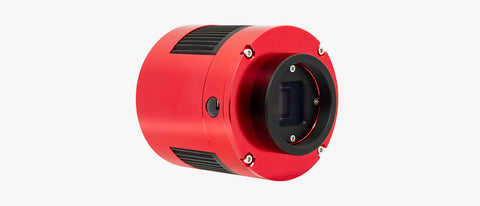
The ZWO ASI533MC Pro is a cooled one-shot-color astronomy camera built on Sony's back-illuminated 9MP IMX533 sensor. It's a natural first dedicated camera for someone moving up from a DSLR or a smart telescope, and it pairs especially well with short refractors from 250 to 500mm. ZWO describes it as the successor to the ASI183 series, keeping the high sensitivity and adding zero amp glow, larger 3.76µm pixels and two-stage TEC cooling. The body is 78mm across and weighs 470g (1.0lb).
Key specs: Sony IMX533 color sensor, 1" square (11.31 × 11.31mm) · 9MP (3008 × 3008) · 3.76µm pixels · 14-bit ADC · read noise 1.0–3.8e⁻ · 50,000e⁻ full well · cooling to 35°C below ambient · zero amp glow · USB 3.0 with 256MB buffer · 470g

What you can image
- Galaxies: the Whirlpool, Pinwheel, Sunflower and Triangulum Galaxies, M81 and M82, and the Leo Triplet. On the 490mm ZWO FF70 the field is about 1.3° × 1.3° at 1.6″ per pixel.
- Round nebulae: the Rosette, the Helix, the Pacman and the Bubble Nebula fit neatly in the square frame.
- Wider fields: on a 250mm RedCat 51 the field grows to about 2.6° × 2.6°, enough for the Heart Nebula's core, the Pleiades or the Orion Nebula with the Running Man.
- Nebulae from the city: with a dual-band filter such as the ZWO Duo-Band, emission nebulae come through even from a light-polluted backyard.
- Globular clusters and comets in natural color, in one shot.
How it works
The camera connects to a computer or an ASIAIR Plus over USB 3.0, and runs its cooler from a 12V supply (ZWO recommends 12V 3A, 5.5 × 2.1mm plug, center positive). Set a target temperature, build a dark library once, and image. Two USB 2.0 ports on the back let you plug in a guide camera or focuser right at the scope.
The sensor sits 17.5mm behind the camera face. The included 21mm and 16.5mm extenders and M42-M48 adapter bring that to the standard 55mm used by most flatteners and reducers, with a thin spacer set for fine-tuning. If you add an off-axis guider, it takes the place of the 16.5mm extender, as shown below.

Using it in Colorado
- Front Range skies: shoot emission nebulae from the city with a dual-band filter, and save galaxies for darker sites like Jackson Lake State Park or the Westcliffe area.
- Big temperature swings: the cooler holds a set temperature as the night cools off, so your darks stay matched. In summer, set the target a few degrees warmer so the cooler has headroom. ZWO doesn't recommend running the camera below −20°C ambient.
What to add for the best results
- 12V power (required for cooling): the ZWO 12V 5A adapter at home, or a PowerTank Lithium Pro in the field.
- ASIAIR Plus: runs the camera, mount, guiding and focuser from your phone.
- ASI220MM Mini: a sensitive guide camera for a guide scope or the ZWO OAG.
- ZWO IR cut filter: the camera has a clear, AR-coated window, so an IR cut filter keeps star colors natural and stars tight on refractors. It threads into the included T2-1.25" adapter.
- A dual-band filter: the ZWO Duo-Band, or an Optolong L-eXtreme in a ZWO M42 2" filter drawer, for nebulae under light pollution.
- ZWO EAFN electronic focuser: keeps stars sharp as the temperature drops.
- A telescope and mount: the ZWO FF70 + AM3N bundle is a well-matched, portable setup for this camera.
ASI533MC Pro vs. ASI533MM Pro vs. ASI2600MC Pro
| ASI533MC Pro | ASI533MM Pro | ASI2600MC Pro (2025) | |
|---|---|---|---|
| Sensor | IMX533 color, 1" square | IMX533 mono, 1" square | IMX571 color, APS-C |
| Sensor size | 11.3 × 11.3mm | 11.3 × 11.3mm | 23.5 × 15.7mm |
| Resolution | 9MP | 9MP | 26MP |
| Filters needed | None (dual-band optional) | Filter wheel and LRGB/narrowband filters | None (dual-band optional) |
| Field on a 490mm scope | 1.3° × 1.3° | 1.3° × 1.3° | 2.7° × 1.8° |
| Best for | An affordable first cooled camera, small refractors and smaller targets | Narrowband from the city and the most detail per pixel | The widest field and the most resolution |
See all ZWO cooled deep-sky cameras.
What's in the box

- ASI533MC Pro camera and camera bag
- 1.25" nosepiece and T2-1.25" adapter
- USB 3.0 cable (2m) and two USB 2.0 cables (0.5m)
- T2-M48 extender (16.5mm), T2 extender (21mm) and M42-M48 adapter
- Four thin spacers (0.5mm, 2 × 0.2mm, 0.1mm) and a cover
- Quick guide
The 12V power supply, filters and guide camera are sold separately.
ZWO ASI533MC Pro FAQ
Is the ASI533MC Pro good for beginners?
Yes. It's color, so there's no filter wheel, it has no amp glow to fight, and its small sensor is forgiving of flattener spacing and tilt. With an ASIAIR the whole workflow runs from your phone.
ASI533MC Pro or ASI2600MC Pro?
Choose the ASI533MC Pro for a lower price, small refractors and smaller targets like galaxies. Choose the ASI2600MC Pro for a field about twice as wide and nearly three times the pixels, if your telescope covers an APS-C sensor.
Color (MC) or mono (MM)?
The MC gives color images in one shot. The ASI533MM Pro needs a filter wheel and filters but is the better choice for narrowband imaging from light-polluted skies.
What telescope works with it?
Almost any imaging telescope with a flattener or reducer set for 55mm back focus. Its 16mm diagonal is covered easily by small refractors like the RedCat 51 and the ZWO FF series.
What power and accessories do I need?
A 12V supply for the cooler, a computer or ASIAIR to run it, and a tracking mount. For long exposures add a guide camera, and for city nebulae a dual-band filter.
Can I image planets with it?
It can, but a small, fast planetary camera such as the ASI715MC or ASI585MC does better on planets. The ASI533MC Pro is built for long deep-sky exposures.
Specifications
| Sensor | |
|---|---|
| Sensor | Sony IMX533, back-illuminated, color |
| Format | 1", 11.31 × 11.31mm (16mm diagonal) |
| Resolution | 9MP, 3008 × 3008 |
| Pixel size | 3.76µm |
| ADC | 14-bit |
| Read noise | 1.0–3.8e⁻ |
| Full well | 50,000e⁻ |
| Peak QE | 80% |
| Amp glow | None |
| Performance | |
| Cooling | Two-stage TEC, 30–35°C below ambient (35°C measured at 30°C ambient) |
| Max frame rate | 20 fps at full resolution |
| Protective window | AR-coated clear window (no IR cut) |
| Physical and connections | |
| Data | USB 3.0 with 256MB DDR3 buffer |
| Hub | 2 × USB 2.0 on the camera body |
| Power | 12V DC for cooling, 3A recommended, 5.5 × 2.1mm center positive (supply not included) |
| Back focus | 17.5mm; 55mm with included extenders |
| Mounting | M42 × 0.75 front thread; 1.25" nosepiece included |
| Body diameter | 78mm |
| Weight | 470g (1.0lb) |
| Model / SKU | ZWO-ASI533MC-P |